Lösningar 16

Matematik för naturvetare 15hp

(Skillnad mellan versioner)
Hoppa till: navigering, sök
Versionen från 16 oktober 2007 kl. 14.13 (redigera)
Clas Löfwall (Diskussion | bidrag)

← Gå till föregående ändring
Nuvarande version (16 oktober 2007 kl. 14.22) (redigera) (ogör)
Clas Löfwall (Diskussion | bidrag)

 
(2 mellanliggande versioner visas inte.)
Rad 100: Rad 100:
t&=&\sqrt 2\, x\\ t&=&\sqrt 2\, x\\
dt&=&\frac{1}{\sqrt 2}\, dx\end{array}\right\}= dt&=&\frac{1}{\sqrt 2}\, dx\end{array}\right\}=
-\frac{1}{\sqrt 2}int\frac{dt}{1+t^2}\\+\frac{1}{\sqrt 2}\int\frac{dt}{1+t^2}\\
&=&\frac{1}{\sqrt 2}\arctan t+C=\frac{1}{\sqrt 2}\arctan(\sqrt 2\, x)+C\end{array}</math> &=&\frac{1}{\sqrt 2}\arctan t+C=\frac{1}{\sqrt 2}\arctan(\sqrt 2\, x)+C\end{array}</math>
Rad 162: Rad 162:
<math> <math>
2\int e^{-x}\cos x\, dx=-e^{-x}\cos x+e^{-x}\sin x+C=e^{-x}(\sin 2\int e^{-x}\cos x\, dx=-e^{-x}\cos x+e^{-x}\sin x+C=e^{-x}(\sin
-x-\cos x)+C\]+x-\cos x)+C</math>
-och \[+ 
 +och
 + 
 +<math>
\int e^{-x}\cos x\, dx=\frac{1}{2}e^{-x}(\sin \int e^{-x}\cos x\, dx=\frac{1}{2}e^{-x}(\sin
x-\cos x)+C'</math> x-\cos x)+C'</math>
Rad 310: Rad 313:
-2\sqrt 2\cos(x/2)+C\end{array}</math> -2\sqrt 2\cos(x/2)+C\end{array}</math>
-Observera att $\sin(x/2)\ge 0$ då $x\in\left[0,\right]$, så att +Observera att $\sin(x/2)\ge 0$ då $x\in\left[0,2\pi\right]$, så att
<math> <math>
Rad 545: Rad 548:
<math> <math>
-P_{d}(12)=\frac{26¹}{3}-18+C,</math>+P_{d}(12)=\frac{26\pi}{3}-18+C,</math>
Rad 556: Rad 559:
För $12\le t\le 24$ avtar $P_{d}$ linjärt på så sätt att För $12\le t\le 24$ avtar $P_{d}$ linjärt på så sätt att
-$P_{d}(12)=26¹/3-5$ och $P_{d}(24)=P_{d}(0)=13$. Detta ger +$P_{d}(12)=26\pi/3-5$ och $P_{d}(24)=P_{d}(0)=13$. Detta ger
<math> <math>
-P_{d}(t)-13=\frac{26¹/3-5-13}{12-24}(x-24)\quad\mbox{eller}\quad+P_{d}(t)-13=\frac{26\pi/3-5-13}{12-24}(x-24)\quad\mbox{eller}\quad
-P_{d}(t)=\frac{27-13¹}{18}t+\frac{26¹}{3}-23.</math>+P_{d}(t)=\frac{27-13\pi}{18}t+\frac{26\pi}{3}-23.</math>

Nuvarande version

[redigera] Lösningar till några övningar till lektion 16

Tillbaka till lösningarna


ETT RÅD: Du kan alltid kontrollera svaret genom att derivera.


9.1.e)

Observera att $\sqrt x=x^{1/2}$.


9.1.f)

Skriv $3/x^3=3x^{-3}$.


9.1.g)

Multiplicera först ihop.


9.1.i)

Skriv $2/e^x=2e^{-x}$.


9.2.e)

Börja med att utveckla kvadraten.


9.2.f)

Gå över till den naturliga exponentialfunktionen: $2^x=(e^{\ln 2})^x=e^{x\ln 2}$.


9.2.g)

$(1+e^{-2x})e^{2x}=e^{2x}+1$


9.2.h)
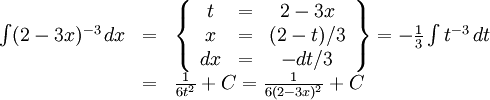
\begin{array}{lll} \int(2-3x)^{-3}\, dx&=&\left\{\begin{array}{ccc} t&=&2-3x\\ x&=&(2-t)/3\\ dx&=&-dt/3\end{array}\right\}= -\frac{1}{3}\int t^{-3}\, dt\\ &=& \frac{1}{6t^2}+C=\frac{1}{6(2-3x)^2}+C\end{array}


9.2.i)

Man kan först förenkla något:

\sin\left(\frac{\pi x}{4}-\frac{\pi}{2}\right)= -\sin\left(\frac{\pi}{2}-\frac{\pi x}{4}\right)= -\cos\frac{\pi x}{4}

De primitiva funktionerna är således

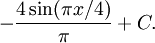
-\frac{4\sin(\pi x/4)}{\pi}+C.


9.2.j)

\begin{array}{lll} \int\frac{1}{1-3x}\, dx&=&\left\{\begin{array}{ccc} t&=&1-3x\\ x&=&(1-t)/3\\ dx&=&-dt/3\end{array}\right\}= -\frac{1}{3}\int  \frac{dt}{t}\\ &=&-\frac{1}{3}\ln|t|+C=-\frac{\ln|1-3x|}{3}+C\end{array}


9.2.k)

Funktionen är lika med $1/(2x^2+1)$.

\begin{array}{lll} \int\frac{dx}{1+2x^2}&=&\left\{\begin{array}{ccc} t&=&\sqrt 2\, x\\ dt&=&\frac{1}{\sqrt 2}\, dx\end{array}\right\}= \frac{1}{\sqrt 2}\int\frac{dt}{1+t^2}\\ &=&\frac{1}{\sqrt 2}\arctan t+C=\frac{1}{\sqrt 2}\arctan(\sqrt 2\, x)+C\end{array}


9.3.a)

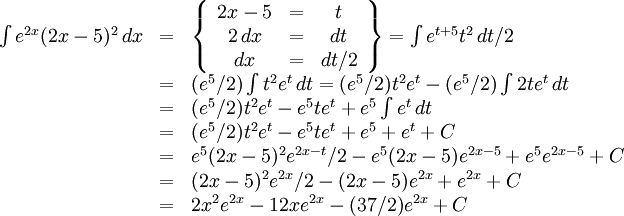
\begin{array}{lll} \int e^{2x}(2x-5)^2\, dx&=&\left\{\begin{array}{ccc} 2x-5&=&t\\ 2\, dx&=& dt\\ dx&=& dt/2\end{array}\right\}= \int e^{t+5}t^2\, dt/2\\ &=& (e^5/2)\int t^2e^t\, dt=(e^5/2)t^2e^t-(e^5/2)\int 2te^t\, dt\\ &=& (e^5/2)t^2e^t-e^5te^t+e^5\int e^t\, dt \\ &=& (e^5/2)t^2e^t-e^5te^t+e^5+e^t+C\\ &=& e^5(2x-5)^2e^{2x-t}/2-e^5(2x-5)e^{2x-5}+e^5e^{2x-5}+C\\ &=& (2x-5)^2e^{2x}/2-(2x-5)e^{2x}+e^{2x}+C\\ &=& 2x^2e^{2x}-12xe^{2x}-(37/2)e^{2x}+C\end{array}


9.3.b)

\begin{array}{lll} \int (3x^3-5)\ln x\, dx&=&(3x^4/4-5x)\ln x-\int (3x^4/4-5x)(1/x)\,  dx\\ &=& (3x^4/4-5x)\ln x-\int(3x^3/4-5)\, dx\\ &=& (3x^4/4-5x)\ln x-3x^4/16+5x+C\end{array}


9.3.c)

\begin{array}{lll} \int\ln(x-1)\, dx&=&(x-1)\ln(x-1)-\int (x-1)\cdot\frac{1}{x-1}\, dx\\ &=& (x-1)\ln(x-1)-\int 1\, dx=(x-1)\ln(x-1)-x+C\end{array}


9.3.d)

\begin{array}{lll} \int e^{-x}\cos x\, dx&=&-e^{-x}\cos x-\int(-e^{-x})(\sin x)\, dx\\ &=& -e^{-x}\cos x-\int e^{-x}\sin x\, dx\\ &=& -e^{-x}\cos x+e^{-x}\sin x-\int e^{-x}\cos x\, dx+C\end{array}


Alltså är

2\int e^{-x}\cos x\, dx=-e^{-x}\cos x+e^{-x}\sin x+C=e^{-x}(\sin  x-\cos x)+C

och

\int e^{-x}\cos x\, dx=\frac{1}{2}e^{-x}(\sin  x-\cos x)+C'


9.3.e)

Använd sambandet $\cos^2x=(1+\cos 2x)/2$:

\int e^{2x}\cos^2x\, dx= \frac{1}{2}\int e^{2x}(1+\cos 2x)\, dx= \frac{1}{4}e^{2x}+\frac{1}{2}\int e^{2x}\cos 2x\, dx

Som en liten finess kan vi använda d) för att beräkna integralen:
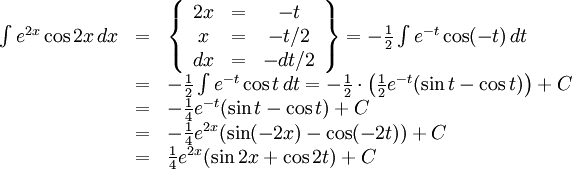

\begin{array}{lll} \int e^{2x}\cos 2x\, dx&=&\left\{\begin{array}{ccc} 2x&=&-t\\ x&=&-t/2\\ dx&=&-dt/2\end{array}\right\}= -\frac{1}{2}\int e^{-t}\cos(-t)\, dt\\ &=& -\frac{1}{2}\int e^{-t}\cos t\, dt= -\frac{1}{2}\cdot \left(\frac{1}{2}e^{-t}(\sin t-\cos t)\right)+C\\ &=& -\frac{1}{4}e^{-t}(\sin t-\cos t)+C\\ &=& -\frac{1}{4}e^{2x}(\sin(-2x)-\cos(-2t))+C\\ &=& \frac{1}{4}e^{2x}(\sin 2x+\cos 2t)+C \end{array}

Svaret är således

\begin{array}{lll} \int e^{2x}\cos^2x\, dx&=&\frac{1}{4}e^{2x}+\frac{1}{2}\cdot  \frac{1}{4}e^{2x}(\sin 2x+\cos 2t)+C\\ &=& \frac{1}{8}e^{2x}(2+\sin 2x+\cos 2x)+C\end{array}


9.3.f)

Om vi sätter $f(x)=\ln x$, så är integranden $f'(x)f(x)$, vilket enligt kedjeregeln är derivatan av $(f(x))^2/2$. Svaret är således $(\ln x)^2/2+C$.


9.3.g)
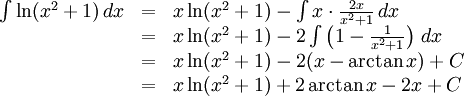
\begin{array}{lll} \int\ln(x^2+1)\, dx&=& x\ln(x^2+1)-\int x\cdot \frac{2x}{x^2+1}\, dx\\ &=& x\ln(x^2+1)-2\int\left(1-\frac{1}{x^2+1}\right)\, dx\\ &=& x\ln(x^2+1)-2(x-\arctan x)+C\\ &=& x\ln(x^2+1)+2\arctan x-2x+C\end{array}


9.4.f)

\int\sin 2x\cos 2x\, dx=\frac{1}{2}\int\sin 4x\, dx=-\frac{1}{8}\cos  4x+C


9.4.h)

\int\frac{1}{8+2x^2}\, dx=\frac{1}{8}\int\frac{1}{1+(x/2)^2}\, dx= \frac{1}{8}\cdot  2\arctan\frac{x}{2}+C=\frac{1}{4}\arctan\frac{x}{2}+C


9.4.i)

\int\frac{1}{x^2-4x+5}\, dx=\int\frac{1}{1+(x-2)^2}\, dx= \arctan (x-2)+C


9.4.j)

\begin{array}{lll} \int\frac{\sqrt{4-2x^2}}{x^2-2}\, dx&=& -\sqrt  2\int\frac{\sqrt{2-x^2}}{2-x^2}\, dx = -\sqrt 2\int\frac{1}{\sqrt{2-x^2}}\, dx\\&=& -\int\frac{1}{\sqrt{1-(x/\sqrt 2)^2}}\, dx = -\sqrt 2\arcsin\frac{x}{\sqrt 2}+C\end{array}


9.4.k)

\int\frac{1}{1-\cos x}\, dx=\int\frac{1}{2\sin^2(x/2)}\, dx= -\frac{1}{2}\cdot 2\, \frac{1}{\tan(x/2)}+C= -\frac{1}{\tan(x/2)}+C


9.4.l)

Använd trigonometriska ettan.


9.5.a)

Använder vi Exempel 9.26 så får vi
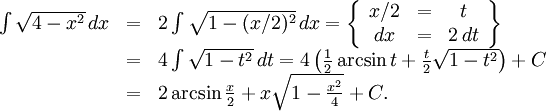
\begin{array}{lll} \int\sqrt{4-x^2}\, dx&=&2\int\sqrt{1-(x/2)^2}\,  dx=\left\{\begin{array}{ccc} x/2&=&t\\ dx&=&2\, dt\end{array}\right\}\\ &=& 4\int\sqrt{1-t^2}\, dt=4\left(\frac{1}{2}\arcsin  t+\frac{t}{2}\sqrt{1-t^2}\right)+C\\ &=& 2\arcsin\frac{x}{2}+x\sqrt{1-\frac{x^2}{4}}+C.\end{array}


9.5.b)

\begin{array}{lll} \int\sqrt{1-\cos x}\, dx&=& \int\sqrt{2\sin^2(x/2)}\, dx= \sqrt 2 \int\sin(x/2)\, dx\\ &=& -2\sqrt 2\cos(x/2)+C\end{array}

Observera att $\sin(x/2)\ge 0$ då $x\in\left[0,2\pi\right]$, så att

\sqrt{\sin^2(x/2)}=|\sin(x/2)|=\sin(x/2).


9.5.c)

\begin{array}{lll} \int\frac{x(x+1)}{x^2+1}\, dx&=&\int\frac{x^2+1+x-1}{x^2+1}\, dx\\ &=& \int\left(1+\frac{x}{x^2+1}-\frac{1}{x^2+1}\right)\, dx\\ &=& x+\frac{1}{2}\, \ln(x^2+1)-\arctan x+C\end{array}


9.5.d)

Integranden är $f(x)f'(x)$, där $f(x)=\arctan x$, som är derivatan av $(f(x))^2/2$. Svaret är således $(\arctan x)^2/2+C$.


9.5.e)

\begin{array}{lll} \int\cos x\ln|\sin x|\, dx&=&\left\{\begin{array}{ccc} \sin x&=&t\\ \cos x\, dx&=&dt\end{array}\right\} =\int\ln|t|\, dt\\ &=& t\ln |t|-t+C=\sin x\ln|\sin x|-\sin x+C\end{array}


9.5.f)

\begin{array}{lll} \int\cos x\cos 2x\, dx&=& \int\cos x(1-2\sin^2x)\, dx=\left\{\begin{array}{ccc} t&=&\sin x\\ dt&=&\cos x\, dx\end{array}\right\}\\ &=& \int(1-2t^2)\, dt=t-\frac{2t^3}{3}+C\\ &=& \sin x-\frac{2\sin^2x}{3}+C\end{array}

Ett annat sätt är att använda additionsformeln för cosinus:

cos(u + v) + cos(uv) = 2cosucosv,

som ger

\cos x\cos 2x=\frac{1}{2}(\cos 3x+\cos x)


och alltså

\int\cos x\cos 3x\, dx=\frac{\sin 3x}{6}+\frac{\sin x}{2}+C.


Verifiera gärna att de två svaren är lika.


9.5.g)

Eftersom $1+\tan^2x=1/\cos^2x$, så är

\begin{array}{lll} \int\sin x\ln\left(\frac{2}{1+\tan^2x}\right)\, dx&=& \int\sin x\ln (2\cos^2x)\, dx\\ &=& (\ln 2)\int\sin x\, dx+2\int\sin x\ln\cos x\, dx\end{array}


Den första integralen är $-(\ln 2)\cos x+C$ och den andra


\begin{array}{lll} \int\sin x\ln (2\cos^2x)\, dx&=&\left\{\begin{array}{cccc} \cos x&=&t\\ \sin x\, dx&=&-dt\end{array}\right\}= -\int\ln t\, dt\\ &=& -(t\ln t-t)+C= -\cos x\ln\cos x+\cos x+C\end{array}


Svaret är således

\begin{array}{lll} &&-(\ln 2)\cos x+2(-\cos x\ln\cos x+\cos x)+C\\ &=& \cos x(2-\ln 2-2\ln \cos x)+C= \cos x(2-\ln(2\cos^2 x))+C.\end{array}


9.5.h)

Sätt $t=x^2$.


9.5.i)

Sätt $t=x^3$.


9.6.c)

\begin{array}{lll} \int\frac{x^3}{\sqrt{1-x^4}}\, dx&=& \left\{\begin{array}{ccc} x^4&=&t\\ x^3\, dx&=&dt/4\end{array}\right\}= \frac{1}{4}\int\frac{1}{\sqrt{1-t}}\, dt\\ &=& \frac{1}{4}\int(1-t)^{-1/2}\, dt= -\frac{1}{2}(1-t)^{1/2}+C =-\frac{\sqrt{1-x^4}}{2}+C\end{array}


9.6.d)

Sätt $t=\cos x$.


9.6.e)

Partialintegrera två gånger:

\begin{array}{lll} \int e^{2x}\cos 3x\, dx&=&\frac{1}{2}e^{2x}\cos  3x+\frac{3}{2}\int e^{2x}\sin 3x\, dx\\ &=& \frac{1}{2}e^{2x}\cos 3x+\frac{3}{4}e^{2x}\sin 3x- \frac{9}{4}\int e^{2x}\cos 3x\, dx\end{array}


(Lägg märke till att de primitiva funktionerna i första och sista ledet inte behöver vara lika.) Löser man ut $\int e^{2x}\cos 3x\, dx$ så får man

\begin{array}{lll} \int e^{2x}\cos 3x\, dx&=&-\frac{4}{13}\left( \frac{1}{2}e^{2x}\cos 3x+\frac{3}{4}e^{2x}\sin 3x\right)\\ &=& -\frac{1}{13}e^{2x}\left(2\cos 3x+3\sin 3x\right)+C.\end{array}


9.6.f)

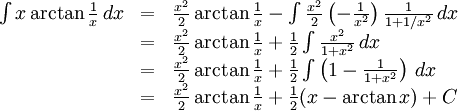
\begin{array}{lll} \int x\arctan \frac{1}{x}\, dx&=& \frac{x^2}{2}\arctan\frac{1}{x}-\int\frac{x^2}{2}\left(-\frac{1}{x^2}\right) \frac{1}{1+1/x^2}\, dx\\ &=& \frac{x^2}{2}\arctan\frac{1}{x}+\frac{1}{2}\int\frac{x^2}{1+x^2}\,  dx\\ &=& \frac{x^2}{2}\arctan\frac{1}{x}+\frac{1}{2}\int\left(1-\frac{1}{1+x^2}\right)\, dx\\ &=& \frac{x^2}{2}\arctan\frac{1}{x}+\frac{1}{2}(x-\arctan  x)+C\end{array}


9.8.

I intervallet $0\le t\le 5$ är $V'(t)\ge 0$, så den maximala volymen fås för $t=5$. Vi har
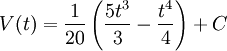
V(t)=\frac{1}{20}\left(\frac{5t^3}{3}-\frac{t^4}{4}\right)+C


och eftersom $V(0)=0,5$ så måste $C=0,5$. Den maximala volymen är således

V(5)=\frac{1}{20}\left(\frac{5\cdot 5^3}{3}-\frac{5^4}{4}\right)+ 0,5=\frac{149}{48}\approx 3\quad\mbox{liter}.


9.9.

Vi studerar först derivatans nollställen och teckenväxlingarna. Vi har $P_{d}'(t)=0\Leftrightarrow 1664-144t-t^3=0$. För att hitta rötterna till tredjegradsekvationen gissar vi heltalsrötter. En heltalsrot måste dela 1664 och man hittar roten $t=8$. Då är $t-8$ en faktor i $1664-144t-t^3$ och division ger $1664-144t-t^3=(8-t)(t^2+8t+208)$. Den andra faktorn har inga nollställen. Vi har alltså

P_{d}'(t)=\frac{(8-t)(t^2+8t+208)}{4(144+t^2)}


och teckenväxlingen vid 8 är $+0-$, vilket visar att 8 är ett lokalt maximum. Syrekoncentrationen är alltså störst 8 timmar efter gryningen.


Vi ska nu bestämma funktionen $P_{d}$. Division ger

P_{d}'(t)=\frac{416}{144+t^2}-\frac{t}{4}=\frac{26/9}{1+(t/12)^2} -\frac{t}{4},


vilket ger

P_{d}(t)=\frac{416}{144}\cdot 12\arctan\frac{t}{12}-\frac{t^2}{8}+C= \frac{104}{3}\arctan\frac{t}{12}-\frac{t^2}{8}+C.


Det minsta värdet av $P_{d}$ antas antingen för $t=0$ eller för $t=12$ (eftersom det finns exakt ett lokalt maximum). Nu är
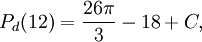
P_{d}(12)=\frac{26\pi}{3}-18+C,


vilket är $>P_{d}(0)=C$. Det minsta värdet är tydligen $C$, dvs $C=13$. Då $0\le t\le 12$ är således

P_{d}(t)\frac{104}{3}\arctan\frac{t}{12}-\frac{t^2}{8}+13.


För $12\le t\le 24$ avtar $P_{d}$ linjärt på så sätt att $P_{d}(12)=26\pi/3-5$ och $P_{d}(24)=P_{d}(0)=13$. Detta ger

P_{d}(t)-13=\frac{26\pi/3-5-13}{12-24}(x-24)\quad\mbox{eller}\quad P_{d}(t)=\frac{27-13\pi}{18}t+\frac{26\pi}{3}-23.

Personliga verktyg